Human Dignity and Welfare Trust logoHUMAN DIGNITYAND WELFARE TRUST
← All projects

ProjectsEk Nayi Subha

Education initiative • Sponsorship proposal

Ek Nayi Subha / A new morning

Back to learning.
Ready for work.
A new beginning.

Help 400 students stay in school and 200 young adults who left education build digital, trade and workplace skills.

A proposed integrated education project by HDW Trust.

Illustrative proposed volunteer support for education
A place to belong.A chance to learn.
A reason to hope.
01Return to schoolReopen the door.
02Arrive preparedRestore confidence.
03Prepare for workBuild practical skills.

The reason to care

“Kal se main bhi
school jaaunga.”

Tomorrow, I will go to school too.

The hope behind this project; not a beneficiary quotation.

The first day matters.
So does every day after.

For a child facing barriers to education, a new bag can bring pride. A school admission can reopen a possibility. A patient teacher can make a difficult lesson feel possible.

Ek Nayi Subha supports underprivileged students who have dropped out or cannot afford to continue school, while opening a separate skills pathway for young adults who left education. School support, essential kits, digital literacy and practical trade training help each person take an appropriate next step.

Your support can help a student continue education or a young adult prepare for work.

One project. Three connected commitments.

Open the door.
Then walk beside them.

Two distinct cohorts: 400 school students receive school support and kits; 200 young adults follow a digital and vocational pathway. Total reach: 600 people, without double counting.

01 /

Back to School & Student Support

“I can stay in school.”

For families facing financial barriers, staying in school can require more than an admission form. This pathway aims to support 400 underprivileged students who have dropped out or cannot afford to continue, through family conversations, school coordination and assessed education assistance.

  • Understand the student’s circumstances with the family, including gaps in attendance and the costs that make schooling difficult.
  • Discuss re-entry or continuation with government schools or other suitable schools, subject to admission availability.
  • Assess documented education expenses against the approved budget before deciding what assistance is possible.
  • Keep a record of support and follow up with families and schools to understand attendance and remaining barriers.
What we will track: Enrolment or continuation, attendance follow-up and approved assistance provided.
02 /

School Readiness Kits

“I am ready to walk in.”

A school bag, well-fitting footwear and the right notebooks can help a student feel ready to participate. This pathway covers practical essentials for the same 400 school students, with items chosen around their age, school requirements and individual needs-not a separate additional cohort.

  • Confirm the school’s requirements and each student’s sizes before arranging bags, notebooks, stationery, uniforms and footwear.
  • Prioritise useful, suitable items and check the quality of supplies before they are accepted or distributed.
  • Coordinate distribution with families and record what each student receives, protecting their privacy and dignity.
  • Ask whether the items fit and can be used as intended; any replacement or additional support depends on assessed need and available resources.
What we will track: Kits delivered, suitability, acknowledgement of receipt and any issues raised.
03 /

Skills to Work

“I can build a working future.”

Leaving school need not close every route to learning. This pathway aims to help 200 young adults aged 18+ explore basic digital skills and a suitable trade, such as fitting or welding, alongside workplace communication and preparation for interviews.

  • Discuss interests, entry requirements and available training routes before agreeing an appropriate pathway with each participant.
  • Plan shared computer sessions covering basic computer use, email, documents and spreadsheets, matched to the starting skill level.
  • Arrange trade learning through suitable partners, with supervised practice, safety instruction and appropriate protective equipment.
  • Help participants prepare CVs and practise interviews; employer introductions depend on suitable openings and do not guarantee a job.
What we will track: Participation, demonstrated skills, interviews or referrals, and confirmed outcomes reported separately.
Two pathways: School students → re-entry / education assistance + kits + attendance follow-up. Young adults → digital skills + a trade pathway + job readiness + employer connections.

A 6-9 month commitment

Schooling for 400.
Skills for 200.
A future for all 600.

We propose a six-month core programme, with support extending to nine months where participants need more time and funding is available. Our target is 400 school students and 200 young adults aged 18+. The vocational model uses four skills centres, 50 participants per centre, with staggered digital sessions and supervised practical training at suitable partner workshops.

Project target: 600 participants · Duration: 6-9 months.
Start date: . Locations, school and training partners, trades and the final timetable remain to be agreed. An itemised planning estimate is provided below. View the budget ↓
Month 1 • Assess & partner

Understand each person’s next step.

Assess 400 school students and 200 young adults; verify financial barriers, school options, age and training eligibility. Select schools and qualified training partners, agree costs and confirm workshop safety arrangements.

Month 2 • Re-enrol & equip

Give each pathway the right tools.

Support school admissions, education assistance and kits. Set up four shared digital labs and complete baseline digital and aptitude checks for the vocational cohort.

Months 3-5 • Learn & practise

Build skills through regular practice.

Follow school attendance and resolve cost barriers. Run digital literacy, workplace communication and the selected fitter or welding pathway, with supervised practical sessions, appropriate PPE and partner-led assessments.

Month 6 • Assess & connect

Prepare for the next step.

Review school continuation and vocational skills. Help young adults prepare CVs, practise interviews and connect with suitable employers or further training. Report referrals and actual outcomes separately; do not promise jobs.

Months 7-9 • Optional follow-through

Support a sustainable transition.

Subject to need and funding, continue supervised practice, job-search support and employer follow-up while monitoring school retention. Avoid repeating one-time kits, lab purchases or initial course fees.

600 participants · A transparent planning estimate

What it could take
to support the journey.

Six months of support for 400 school students and 200 young adults, with an optional three-month extension. Start date: .

Six-month fundraising estimate₹91,95,900.00Includes 5% contingency
Optional months 7-9₹9,59,700.00Additional support, subject to need and funding
Full nine-month estimate₹1,01,55,600.00For the same 600 participants

Six-month core programme

Six-month itemised estimate
ItemQuantity & assumed rateEstimate
School bags400 × ₹350.00₹1,40,000.00
Notebook sets400 × ₹300.00₹1,20,000.00
Stationery sets400 × ₹150.00₹60,000.00
Uniform sets400 × ₹650.00₹2,60,000.00
Footwear pairs400 × ₹350.00₹1,40,000.00
School re-entry, documentation & family support400 × ₹2,500.00₹10,00,000.00
Needs-based education assistance reserve (up to per student)400 × ₹6,000.00₹24,00,000.00
Skills-centre setup & shared furniture4 × ₹25,000.00₹1,00,000.00
Digital lab setup (5 shared computers + peripherals per centre)4 × ₹1,20,000.00₹4,80,000.00
Trade training partner fees (one pathway per participant)200 × ₹8,000.00₹16,00,000.00
Workshop access & practical consumables200 × ₹2,500.00₹5,00,000.00
Trade-specific safety equipment / PPE allowance200 × ₹1,500.00₹3,00,000.00
Digital & employability facilitator months (4 × 6)24 × ₹15,000.00₹3,60,000.00
Skills-centre space months (4 × 6)24 × ₹15,000.00₹3,60,000.00
Utilities, connectivity & cleaning centre-months (4 × 6)24 × ₹2,000.00₹48,000.00
Participant travel support allowance200 × ₹1,500.00₹3,00,000.00
Assessment, interview & employer-linkage support200 × ₹1,000.00₹2,00,000.00
Programme coordination months (2 × 6)12 × ₹20,000.00₹2,40,000.00
School and skills progress monitoring600 × ₹100.00₹60,000.00
Procurement transport & distribution1 × ₹40,000.00₹40,000.00
Miscellaneous expenses1 × ₹50,000.00₹50,000.00

What this revised estimate assumes

  • 600 unique participants: 400 school students receive support and kits; 200 young adults aged 18+ receive job-readiness training. These are distinct cohorts.
  • School assistance: ₹2,500 per student supports outreach and re-entry. A separate reserve of up to ₹6,000 per student covers assessed, approved education expenses. Actual support follows verified need; these are not standard government-school fees or unconditional cash grants.
  • Digital setup: four centres, each with five shared computers and peripherals within a ₹1,20,000 setup allowance. Staggered small-group sessions serve 50 trainees per centre. Hardware prices and specifications need quotations.
  • Trade training: each young adult selects one appropriate pathway, such as fitting or welding, after eligibility and aptitude checks. Course fees, workshop access, consumables and PPE are separate estimates; partner quotations must remove any overlapping charges.
  • Practical delivery: use suitably equipped partner workshops and qualified instructors. The budget does not assume building or purchasing four industrial workshops. No accredited certificate or employer placement is promised before agreements are verified.
  • Operating costs: retain your ₹25,000 setup allowance and ₹15,000 monthly space allowance per centre, for four skills centres.
  • Other support: participant travel is for the vocational cohort. School transport, meals and any education costs beyond the approved reserve require separate funding.

School placement: prioritise suitable government schools or the best possible school available for the student’s needs, accessibility, admission availability and approved funding. Support underprivileged students who have dropped out or cannot afford to continue; private-school admission is not guaranteed.

Miscellaneous expenses: ₹50,000 is a separate one-time programme allowance for minor needs not covered by the listed items. The 5% contingency remains an additional reserve for unforeseen costs. Centre setup and miscellaneous costs are not repeated in the optional three-month extension.

Optional extension: months 7-9

This extension assumes continued skills and employment support for up to 200 young adults plus school-retention monitoring for 400 students. The final extension scope will follow the six-month review.

Optional three-month extension estimate
ItemQuantity & assumed rateEstimate
Digital & employability facilitator months (4 × 3)12 × ₹15,000.00₹1,80,000.00
Skills-centre space months (4 × 3)12 × ₹15,000.00₹1,80,000.00
Utilities, connectivity & cleaning centre-months (4 × 3)12 × ₹2,000.00₹24,000.00
Programme coordination months (2 × 3)6 × ₹20,000.00₹1,20,000.00
Additional supervised practice allowance200 × ₹1,000.00₹2,00,000.00
Additional participant travel allowance200 × ₹750.00₹1,50,000.00
Final progress review & employer follow-up600 × ₹100.00₹60,000.00

A practical sponsorship starting point: estimated school essentials are ₹1,800 per child. Across both cohorts, the six-month programme averages ₹15,326.5 per participant, including shared delivery costs and contingency. These are planning averages, not fixed-price guarantees or direct cash payments to participants.

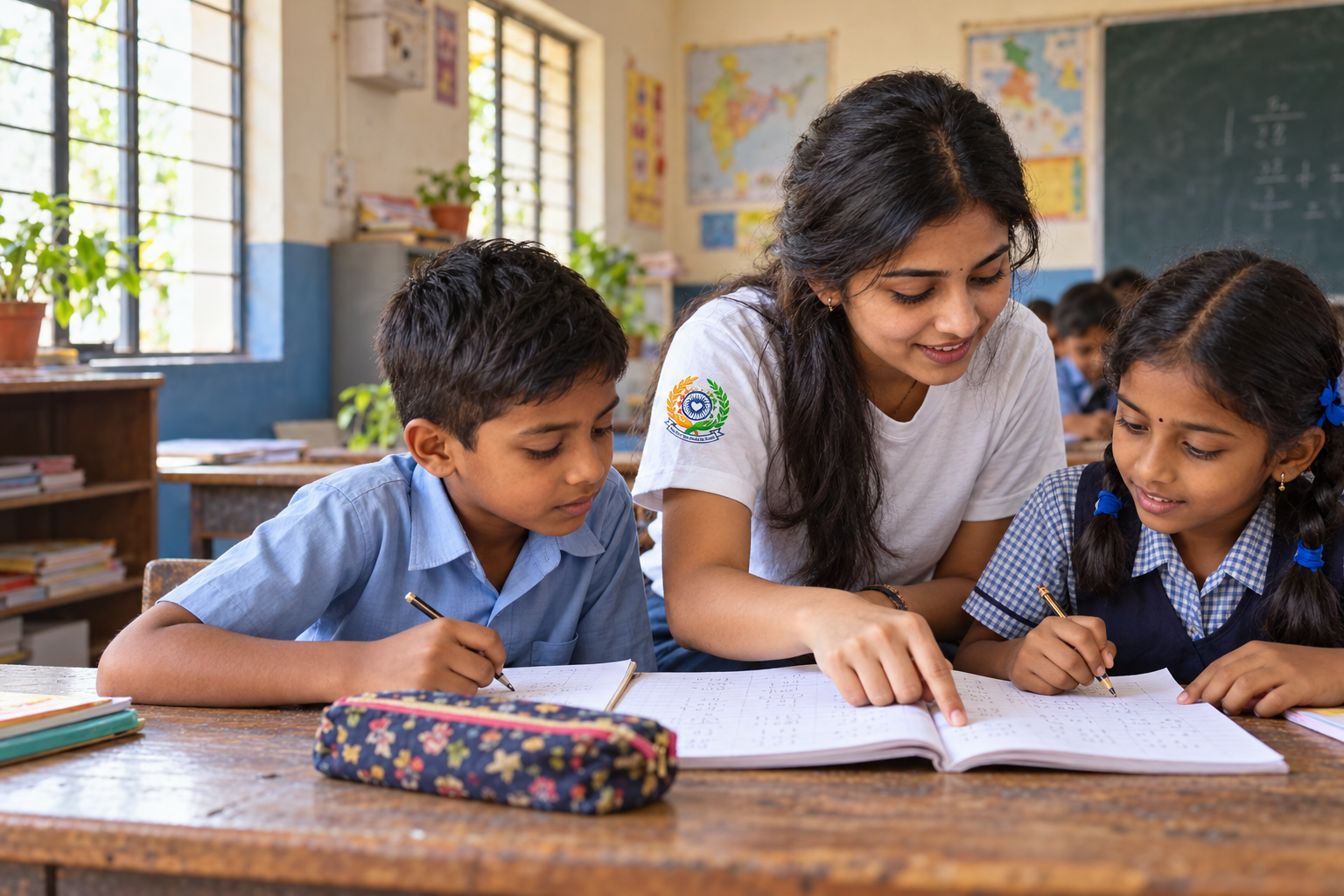
Your contribution can take many forms

Give what you can.
Help someone take a step forward.

You do not have to give money to take part. Useful materials, time, knowledge, space and professional connections can support the programme when they match a confirmed need.

01

Give useful materials

Offer school bags, notebooks, stationery, uniforms or footwear against an agreed requirement list. Confirm quantities, specifications and sizes before purchasing or delivering items.

Offer school materials ↗
02

Help build a digital lab

Offer working computers, laptops, monitors or peripherals. Share the specifications and condition first; arrange removal of personal data and agree suitability before handover.

Offer computers and equipment ↗
03

Offer a suitable space

Help identify a classroom, computer room or training space. Access, timings, utilities, safety, permissions and any costs need to be agreed before use.

Offer space partnership ↗
04

Share your time and skills

Offer digital-literacy teaching, CV guidance, mock interviews, mentoring or school outreach. Roles will be matched to needs, availability and relevant experience, with orientation and safeguarding checks where appropriate.

Offer volunteer skills ↗
05

Become a training partner

Training providers can offer suitable course seats, instructor time, supervised workshop access, consumables or safety equipment. Agree entry requirements, supervision, costs and assessment arrangements first.

Offer training partnership ↗
06

Open a door to work

Employers can share genuine vacancies, offer workplace exposure where suitable, review CVs or conduct interviews. Participation and hiring remain subject to eligibility and the employer’s selection process.

Offer employer partnership ↗

How to offer support

  1. Tell us what you can offer. Share the items or skills, quantity or experience, location and availability using the relevant enquiry link.
  2. Agree the fit before committing. The trust will discuss current needs, suitability, responsibilities and any costs. Please wait for confirmation before buying goods, sending equipment or arranging a visit.
  3. Confirm the handover or role. Agree delivery or session dates and a contact person. Accepted contributions should be recorded and acknowledged, with their intended use documented.

How this affects the budget: accepted in-kind contributions may reduce the corresponding cash requirement. They will be recorded separately from money received; an offered item is not counted as delivered, and its value is not added to the funding graphic.

Direct contact with children or trainees must follow the trust’s agreed supervision and consent arrangements. Course accreditation, tax benefits and employment outcomes are not implied by an offer of support.

A promise deserves a plan

Clear responsibilities.
Visible progress.
Dignity throughout.

The proposed delivery structure assigns a project coordinator to family and school follow-up, an education lead to school support and a skills lead to training partnerships, and a finance contact to expense records and sponsor reporting.

Before launch, HDW Trust should confirm the people responsible for these roles and agree the reporting schedule with sponsors.

Children’s support must never depend on photographs, public stories or contact with donors. Reporting should protect their identity and dignity.
  • Before support beginsAn agreed scope, needs-based selection criteria, itemised costs and a clear funding period.
  • During deliveryPurchase records, kit acknowledgement, session attendance and follow-up on barriers to participation.
  • Progress that mattersEnrolment where needed, school continuation, digital and trade skills, employer referrals and confirmed employment outcomes reported separately.
  • Updates to supportersMonthly activity and spending summaries, a six-month outcome review, and a nine-month closing report where the programme is extended.
  • Responsible handling of changesDiscuss significant budget or scope changes with the sponsor, including the treatment of unused restricted funds.
NGO Darpan IDKA/2026/1216501
Darpan ID StatusActive
Visit NGO Darpan ↗

Before you partner with us

A few thoughtful questions.

Is this project already running?

This is a project and sponsorship proposal with a target of 600 participants and a start date of . The target is not a count of participants already supported, and no completed results are claimed. Please contact HDW Trust to confirm the current launch status, location and delivery arrangements.

Can I sponsor a specific part of the project?

Discuss school essentials, learning support or a centre partnership with the trust. The scope, duration and costs should be agreed in writing before funds are committed. The aim is consistent support based on assessed needs.

Can I donate materials instead of money?

Please request the current requirements first. School specifications, age suitability, uniform sizes, footwear sizes and storage capacity should guide any in-kind donation.

How do I receive payment details and documentation?

Contact the trust using the email or phone below. Request verified payment instructions, the receipt process and applicable registration or tax documentation before donating. This proposal makes no claim about tax deductions or CSR eligibility.

Will supporters receive photographs of children?

Progress reporting can use anonymised summaries and records. Identifiable photographs or stories should only be shared with appropriate consent and safeguarding checks; they are not a condition of receiving support.

Insaniyat Har Zindagi Ke Naam

Help make “I wish I could”
become “I’m ready to begin.”

A place in school. A chance to learn a trade.
The support to take a confident next step.